Drew Ludwig · 13 September 2026
Tracing the Cellular Architecture of Timber for Advanced Acoustic Panel Applications
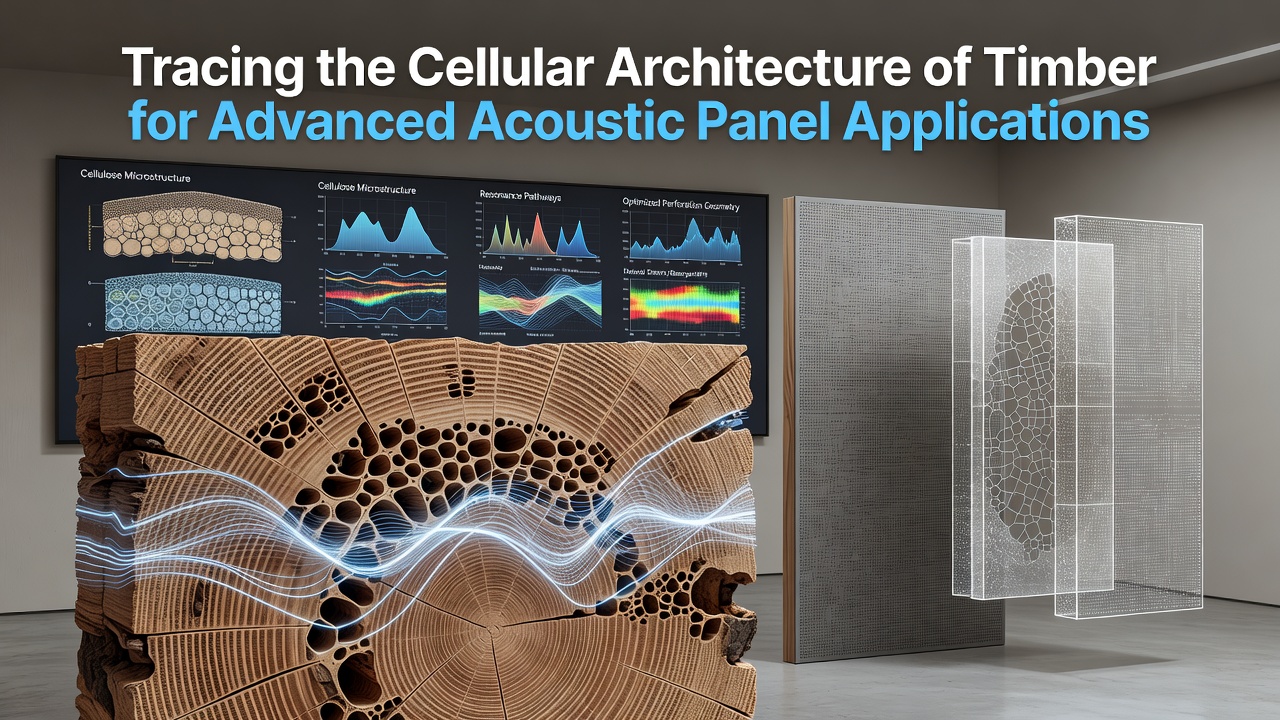
Researchers map the cellular architecture of timber to refine acoustic panel performance, and studies reveal how tracheids, vessels, and ray parenchyma interact with sound waves across different species. Data from forestry laboratories indicate that cell wall thickness and pit membrane density directly influence porosity levels, which in turn affect absorption coefficients in the 250 to 4000 Hz range.
Cellular Components and Their Acoustic Roles
Softwood species such as spruce and pine contain longitudinal tracheids that form the primary structural framework, while hardwood species feature vessel elements alongside fibers. These vessels create larger pathways for air movement, and observations from scanning electron microscopy show that vessel diameter distributions vary by growth ring position. Ray cells, oriented radially, contribute perpendicular permeability that researchers quantify through fluid flow tests, and this radial connectivity supports energy dissipation when panels are mounted in building cavities.
Cell wall lignification levels also matter because higher lignin content increases stiffness while reducing viscoelastic damping. Measurements taken at multiple European research stations demonstrate that earlywood tracheids with thinner walls absorb more low-frequency sound than latewood zones with denser packing. Pits connecting adjacent cells further modulate airflow resistance, and automated image analysis tools now count pit frequency per square millimeter to predict overall panel impedance.
Imaging and Mapping Techniques
Scientists combine micro-computed tomography with confocal laser scanning to generate three-dimensional reconstructions of timber blocks before panel fabrication. These reconstructions allow segmentation of cell lumens from cell walls, and algorithms calculate porosity gradients along the radial and tangential directions. Australian research groups have published datasets showing that automated pore network modeling correlates strongly with measured sound absorption when samples are tested in impedance tubes.
September 2026 marks the scheduled release of an updated international protocol for digital wood anatomy under the auspices of the International Association of Wood Anatomists, and participating laboratories plan to standardize file formats for cell-level data exchange. This protocol will facilitate comparison of datasets collected across North American and Scandinavian facilities, where humidity-controlled scanning environments already minimize sample distortion during imaging.

Integration into Panel Manufacturing
Manufacturers select timber feedstock based on cellular metrics rather than bulk density alone, and sorting lines now incorporate near-infrared sensors that estimate cell wall thickness distributions in real time. Panels produced from pre-sorted batches exhibit more consistent absorption spectra, according to quality control records from Canadian composite mills. Surface perforations are then aligned with underlying cell orientations to avoid blocking high-permeability zones that otherwise enhance mid-frequency performance.
Adhesive application rates are adjusted according to lumen volume measurements, because excessive resin fills pathways that would otherwise allow sound penetration. Industry reports from New Zealand forestry research document a 12 to 18 percent improvement in weighted sound absorption coefficients when adhesive dosing follows cell lumen data rather than average density targets. Post-processing treatments such as thermal modification further alter pit membrane permeability, and controlled trials at Japanese testing centers confirm that moderate thermal exposure increases absorption without compromising structural integrity.
Performance Validation and Standards
Acoustic testing follows ISO 10534-2 protocols in laboratories across multiple continents, and round-robin exercises confirm that cell-architecture-informed panels meet or exceed Class A absorption ratings more reliably than traditionally graded products. Finite element models incorporate the segmented cellular geometries to simulate wave propagation through panel thickness, and validation against physical measurements shows root-mean-square errors below 0.05 in normalized absorption values. Regulatory bodies in the European Union reference these models when updating green building certification criteria that reward optimized material use.
Conclusion
Continued refinement of cellular tracing methods supplies manufacturers with precise selection criteria that translate directly into measurable acoustic gains. Ongoing standardization efforts scheduled for 2026 will support broader data sharing, and collaborative research networks continue to expand the range of timber species evaluated for next-generation panel systems.