
Vera Vogel · 11 October 2026
Density Mapping Techniques Applied to Woodnucleus for Bridge Building Advancements
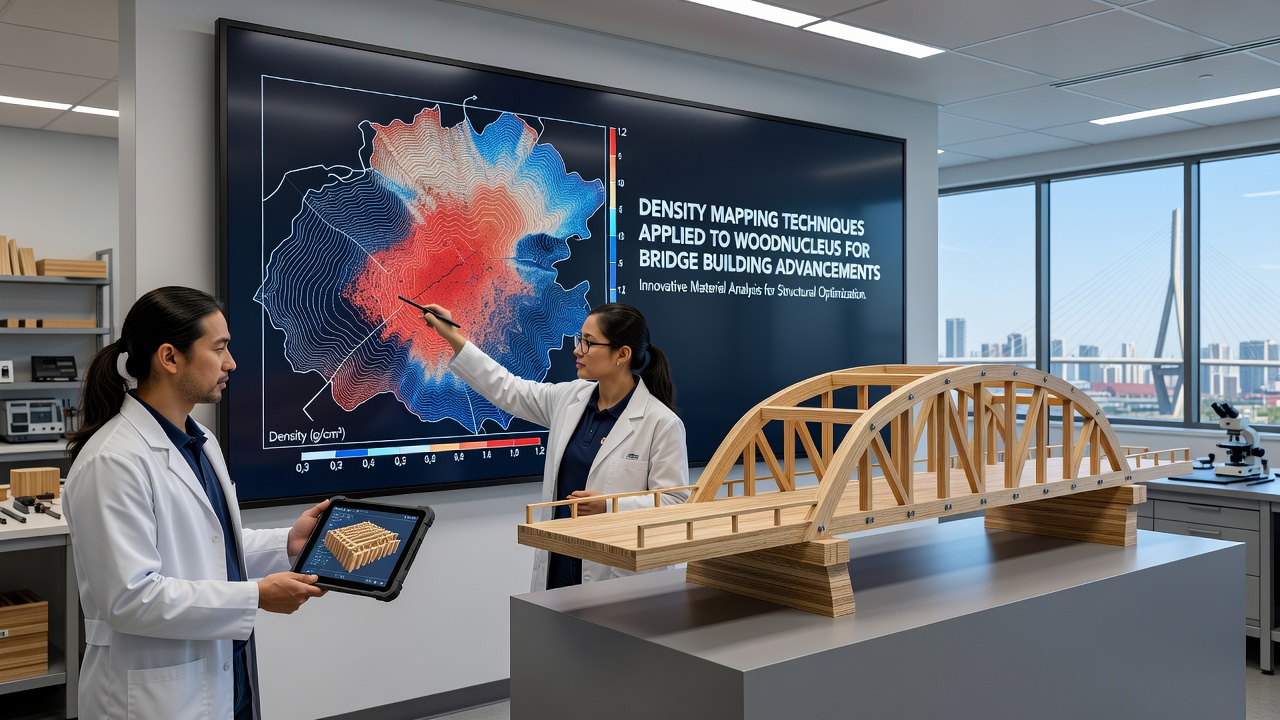
Woodnucleus serves as an engineered wood composite designed for high-load structural applications, and density mapping techniques have become central to its evaluation in bridge construction projects. These methods measure internal density distributions across wood fibers and resin matrices, allowing engineers to predict load capacity and identify potential weak zones before installation. Research indicates that uniform density profiles in woodnucleus correlate with improved fatigue resistance under repeated traffic loads, while variations often signal manufacturing inconsistencies that affect long-term performance.
Core Techniques in Density Assessment
Multiple non-destructive testing approaches deliver precise density data on woodnucleus samples. X-ray densitometry passes controlled radiation through material sections to generate grayscale images where lighter areas represent lower density zones, and this process operates at resolutions down to 0.1 millimeters. Ultrasound pulse velocity measurements send acoustic waves through the composite, with travel times revealing density gradients because denser regions transmit sound faster than voids or resin-poor areas. Computed tomography scanning builds three-dimensional models by rotating samples under X-ray sources, producing voxel-based density maps that highlight fiber alignment and adhesive distribution patterns throughout each panel.
Those who apply these tools often combine them sequentially. Initial ultrasound screening flags suspect regions on large woodnucleus beams, after which targeted CT scans provide detailed internal views without cutting the material. Data shows that integrating outputs from both methods reduces false positives in defect detection by up to 35 percent compared with single-technique protocols, according to reports from timber engineering laboratories in North America and Europe.
Integration into Bridge Design Processes
Bridge designers incorporate density maps during material selection and structural modeling phases. Finite element analysis software imports density datasets to assign variable stiffness values across woodnucleus components, creating more accurate simulations of deflection under live loads. In projects completed since 2024, teams have used these models to adjust cross-bracing placements and joint reinforcements, resulting in documented reductions in peak stress concentrations at connection points. Australian research groups at the University of Melbourne have published findings on similar approaches applied to hybrid timber-steel bridges, demonstrating how mapped density data supports optimized span lengths.
October 2026 marks the scheduled rollout of updated international guidelines from the International Timber Bridge Association that explicitly reference density mapping requirements for woodnucleus acceptance criteria. These guidelines establish minimum density thresholds and acceptable variation limits derived from field performance data collected across multiple climate zones. Implementation timelines align with ongoing pilot installations in Canada, where provincial transportation departments are testing mapped woodnucleus decks on secondary road crossings.
Case Examples from Recent Installations
One documented application occurred on a 42-meter pedestrian bridge in Scandinavia, where pre-installation density mapping of all woodnucleus girders identified three panels with localized low-density pockets near edges. Replacement of those panels before erection prevented potential serviceability issues, and post-construction monitoring over 18 months confirmed stable performance metrics. Another project in the Pacific Northwest region of the United States applied similar protocols during rehabilitation of a historic covered bridge, substituting original timber with density-verified woodnucleus elements to extend service life while maintaining aesthetic requirements.
Industry organizations such as the Canadian Wood Council have compiled comparative datasets showing that bridges incorporating density-mapped woodnucleus exhibit lower maintenance intervention rates during the first five years of operation compared with unmapped alternatives. These figures stem from standardized inspection records submitted by member agencies across provinces.
Future Developments and Standardization Efforts
Advances in portable scanning equipment now allow on-site density verification during bridge assembly, reducing reliance on laboratory pre-testing. Portable CT units mounted on inspection vehicles produce real-time maps that construction crews can reference immediately, enabling adjustments to fastening patterns or load distribution plates as work progresses. European Union-funded research consortia are exploring machine learning algorithms trained on existing density datasets to predict long-term performance outcomes from initial scan results alone.
Standards bodies continue to refine acceptance criteria based on accumulated performance records. The transition toward mandatory density mapping protocols reflects broader industry shifts toward data-driven material qualification rather than visual grading alone.
Conclusion
Density mapping techniques applied to woodnucleus deliver measurable improvements in bridge component reliability through detailed internal characterization. Continued refinement of scanning methods, combined with updated guidelines scheduled for October 2026, supports wider adoption in transportation infrastructure. Available performance data from multiple regions confirms that these practices contribute to consistent structural outcomes across varied environmental conditions.